

Our own scores that grade workouts and athletes
We built our own measures, so a coach can see how balanced training is and who did the most work.
The problem
Most talk about training is opinion. Is this program balanced? Who really did the most work? A good coach wants an answer with a number behind it.
No tool gave us those answers. So we made our own measures.
What we built
WOD Intel reads almost 7,000 public workouts. It sorts each one by movement, workout length and load. Then it scores the whole record.
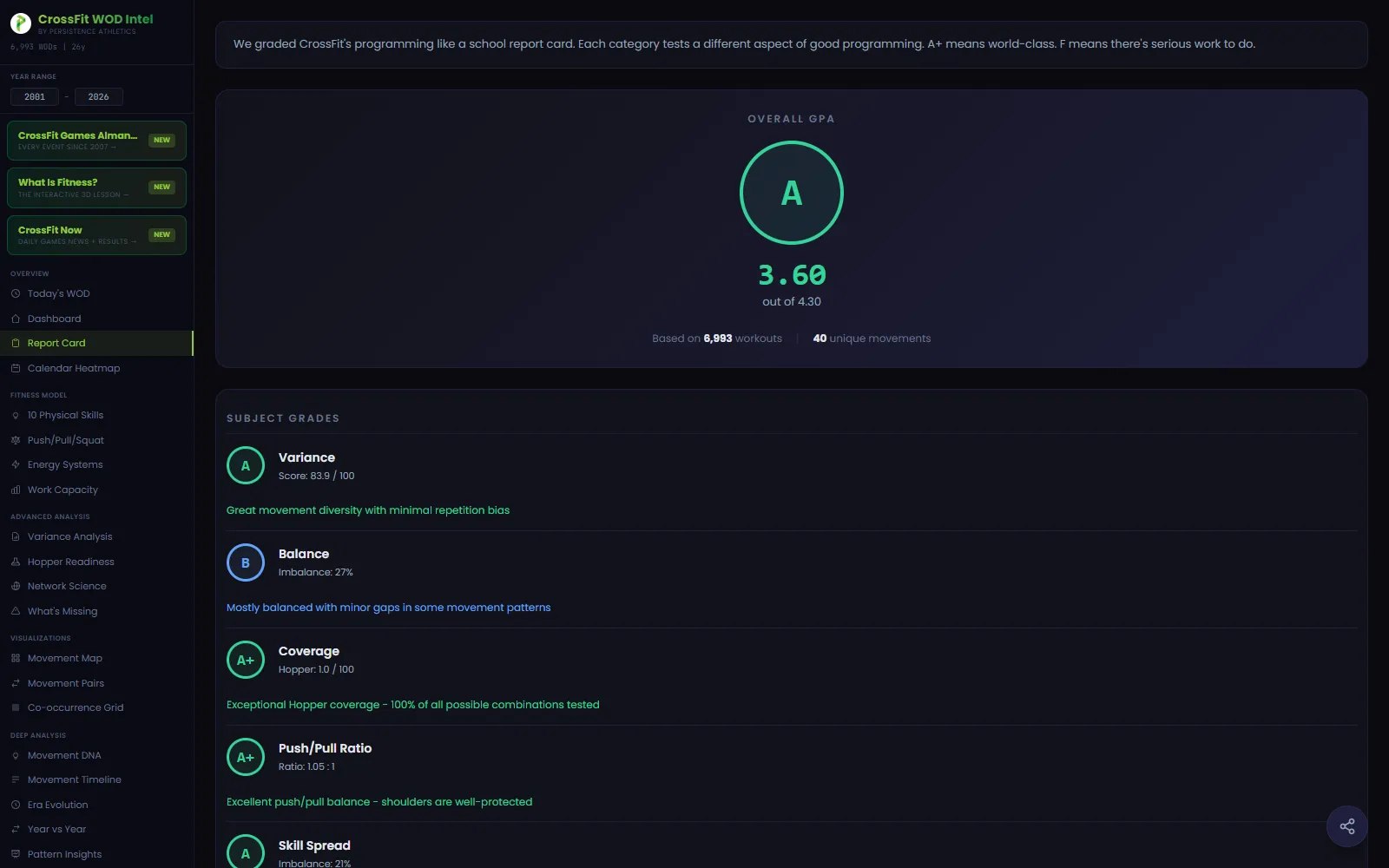
- Report CardGrades from A+ to F on six things: variety, balance, coverage, push and pull, skills and energy.
- Capacity ScoreFor the Games, one number for how much work an athlete did across all events.
- Coverage checkShows which mixes of movement and workout length never get used.
- Variety checkShows if a few movements carry most of the work.
How it works
- Every morning, the new workout is read and sorted.
- It is added to the record, and every score is worked out again.
- Each score becomes a plain grade or a short note a coach can read in seconds.
- A Games athlete is scored by their share of the best result in each event.
- Where the data has gaps, the score says so.
What changed
Coaches can now check a program against 25 years of workouts. The Report Card shows the strongest area and the weakest one.
The Capacity Score lets anyone compare athletes across years on one fair scale. Each score comes with a short note that says what it means.
We built this for our own gym. The same method can grade any set of training or any other pile of records.
Built with
- React
- TypeScript
- Vite
- Recharts
- Three.js
- GitHub Actions