
We turned two courses into narrated, animated lessons in eight days
The idea: lessons that explain themselves
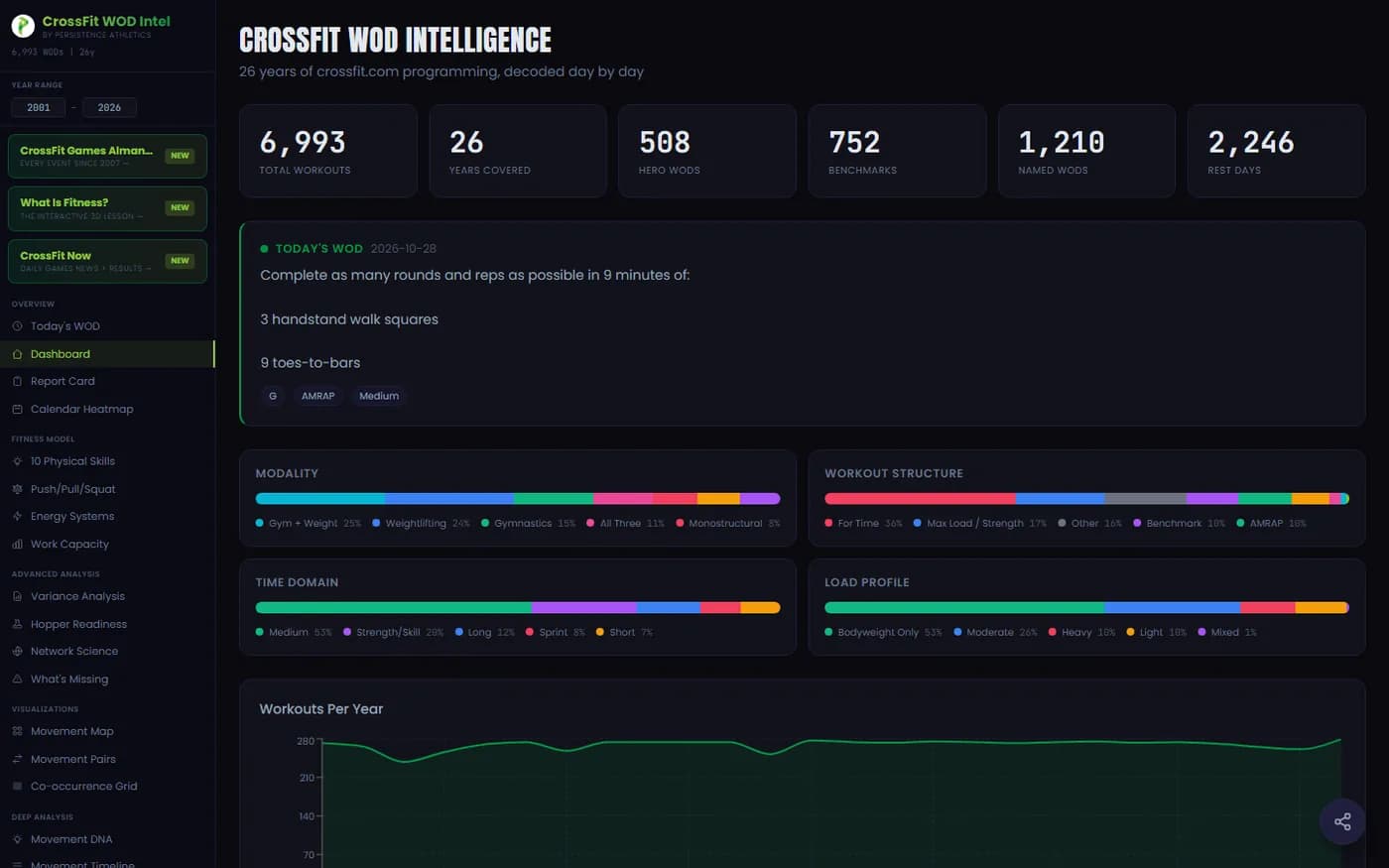
Persistence Athletics is our own gym, a CrossFit gym in Belltown, Seattle. We run it on the system we build, so we feel every bug first. It also teaches more than workouts.
Its site has a lesson on CrossFit's definition of fitness, built on Greg Glassman's original article and the CrossFit Level 1 Training Guide. A sister site has an eight-module course on metabolic health, written by our founder.
Both were text, and both explain ideas that move: energy systems trading places as an effort gets longer, electrons moving down a chain of proteins inside a cell, an insulin signal that stops halfway to where it was going.
We wanted both to work the way a coach does on the floor: a picture that moves while a voice explains it, one idea at a time. Eight days later both were live.
The fitness lesson has eight chapters at wod.persistenceathletics.com/fitness. The metabolic health course has eight modules, a short bridge before each one and a trailer. Together they carry 144 narrated clips.
The steps, end to end
Every lesson goes through the same eight steps. None of them is exotic. The value is in doing all of them, in order, every time the script changes.
- Hold it to the source. Every caption and every spoken paragraph points at a line in its source text, and nothing on screen may claim more than its source does.
- Plan before building. Each idea becomes a short scene with a goal, its labels and its timing, written and reviewed before anyone builds it.
- One clock. A single clock drives every scene, so any moment in any lesson has an address: a scene and a time. That one choice is what makes everything after it testable.
- A script that explains. The narration is written to explain, not to read out the captions, one paragraph per scene.
- A voice with checks that can fail. A synthetic voice (Google's Gemini) reads one paragraph per take. Every take is turned back into text and checked: its first seconds on their own, its pace, its pauses, and hard terms like NADH and Complex IV.
- Timing. We find when each word is spoken and tie each moving part of the picture to the phrase that names it, so the picture follows the voice.
- Checks on real devices. Sound checks, a check for blank frames, and phone checks in both Chrome and Safari.
- Preview, then live. Each round went to a private preview on the gym's own site. We reviewed it there as the gym, and only then made it live.
Why one clock matters to a business
The single clock sounds like an engineering detail. It is the reason the lessons are cheap to keep up. Any moment in any lesson can be opened with a link.
So every frame can be saved and compared, and every problem anyone reports can be shown again exactly. Pictures for articles are real frames, not mockups. Short social clips come straight from the lessons, with no new animation.
It also made rewrites cheap. The scripts changed in every round of review. With a synthetic voice, a rewrite is a re-run, not a studio booking. So the review kept going until the lessons were right, instead of stopping when the budget ran out.
What the checks caught, and what only real use caught
The checks earned their keep. The voice sometimes read its own stage directions out loud before the paragraph. A simple text check missed it, because the tool that turns speech into text tended to drop the same sentence. Checking the first seconds of every clip on its own caught it every time after that.
We caught the rest by using the lessons on a phone, the way a member would. A quiet background chord came across as a hum. A chapter menu drew off-screen on iPhones, because Safari handles a blurred header differently from Chrome, where every automated phone test had run.
A course used its central term, reactive oxygen species, across several modules without ever defining it. And the modules felt like separate lectures, which is why each one now opens with a short bridge that shows where you are in the course. Every one of those became a fix and, where it could, a new check.
What we cannot claim yet
The lessons shipped this week. There is no completion data, no comparison with the text they replaced, and no evidence yet that anyone learns more from them. The 144 clips are clips that passed our checks, not proof that the checks are complete. We will report what the numbers show once there are numbers.
Where this fits your business
Any business that explains the same things again and again has the raw material for this: a course, client onboarding, a standard way of doing a job, a product that is hard to picture.
You need three things: a source of truth the lesson can be held to, an owner who will use the result the way a customer would, and checks that can actually fail. The animation is the part people see. The checking is the part that makes it trustworthy.